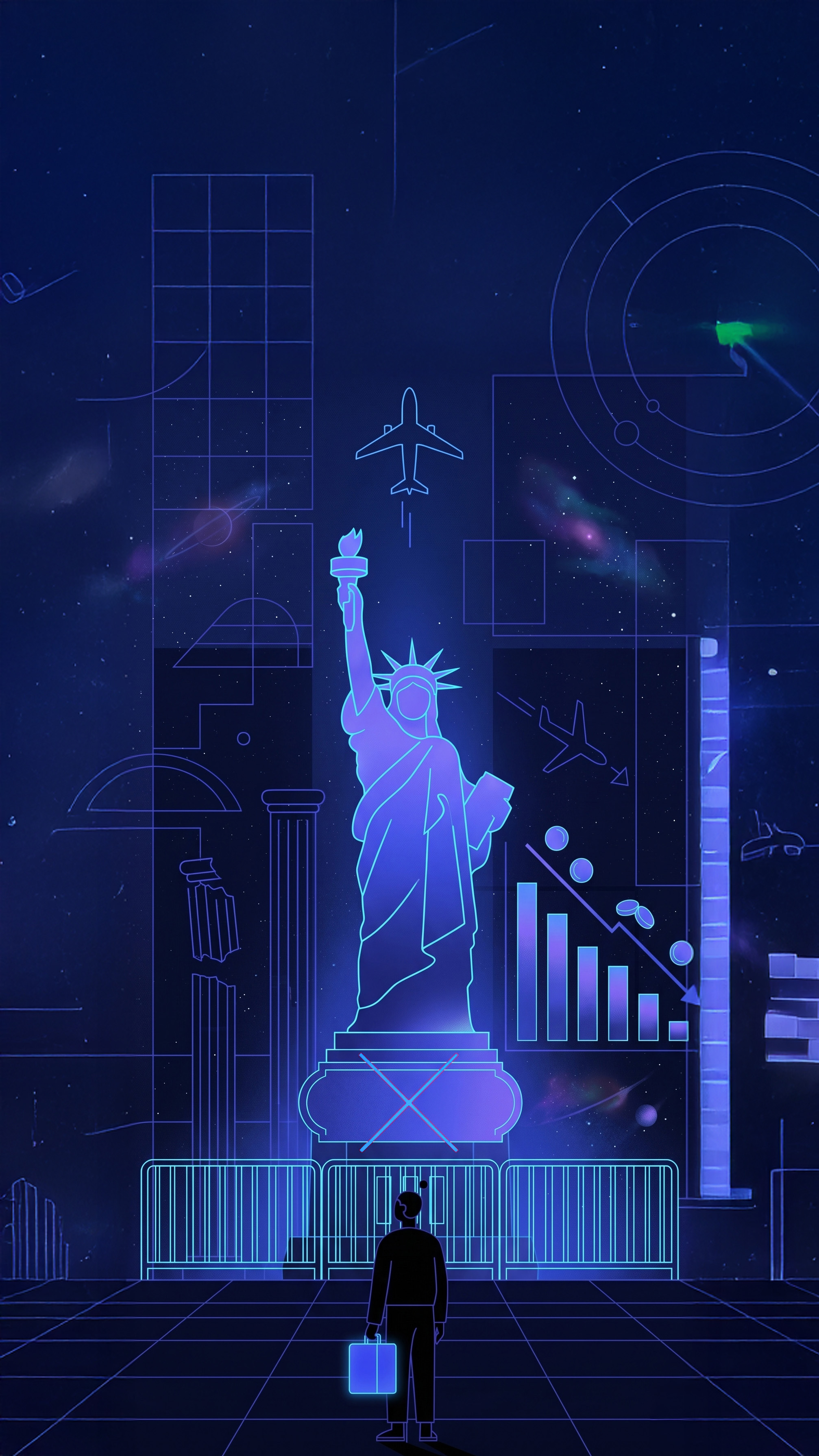

Tourism is one of the most sensitive seismographs of a country's reputation. Subtler than polls, faster than diplomatic reports and often more honest than official statements. Before a person buys an airline ticket, they answer a simple question: do I really want to go there?
They are not asking only about the weather, museums, restaurants and the price of a hotel. They are asking about something less visible, but absolutely fundamental: will I be welcome there? Will crossing the border be an ordinary procedure, or an emotional exam? Will the country selling me a dream treat me at the door like a suspect? In tourism, the decision begins long before the hotel lobby. It begins in the imagination.
That is why the decline in inbound tourism to the United States in 2025 is more than an industry statistic. This is not only a story about hotels in Las Vegas, restaurants in New York, theme parks in Florida or stores along the Canadian border. It is a story about the fact that even the world's largest economy can begin to pay the bill for lost trust.
And in hospitality, trust is a harder currency than the dollar. The dollar can be printed. Trust - not so much.
The tourist votes with their feet
According to the latest forecasts and industry data, the United States welcomed about 68.3 million international visitors in 2025. That was 5.5% fewer than the year before. In absolute terms, it means more than 4 million fewer visits. For a country that in 2019 received around 79 million foreign travelers, this is not a minor post-pandemic adjustment, but a clear reversal of the recovery trend.
The more important point, however, is something else: global tourism did not collapse. On the contrary. The global number of international tourist arrivals rose in 2025 to about 1.52 billion. People did not stop traveling. They did not shut themselves indoors. They did not decide the world was too expensive, too complicated or too uncertain. They simply chose destinations other than the United States more often.
That is the essential difference. When an entire market falls, one can speak of the business cycle, inflation, fuel prices, currencies and consumer fatigue. But when the world is traveling more, while one of the most important destinations is recording a decline, the problem stops being merely economic. It becomes reputational.
As early as May 2025, the World Travel & Tourism Council warned that the United States could be the only one of 184 economies analyzed to record a fall in international visitor spending. The projected shortfall then stood at $12.5 billion. Later data showed that international tourism spending in the United States did indeed weaken, while the global travel and tourism sector continued to grow. In other words: the problem was not that people stopped spending money on travel. The problem was that some of them stopped spending it in the United States.
This distinction is crucial for hoteliers, investors and everyone who lives from the experience economy. A tourist has no obligation to come. They are not a customer assigned to a brand forever. Even if for decades they chose a given destination out of habit, sentiment or prestige, in one season they may discover that an alternative is more pleasant, simpler and less risky. And changed travel habits can prove surprisingly durable.
A country's hospitality begins at the border
In hospitality, we like to say that the first impression is formed at reception. In international tourism, the country's reception desk is the airport, port or border crossing. A border officer is not, of course, a concierge, but for the traveler they perform a similar symbolic function: they are the first person to tell them whether they are a guest or a problem.
A state has the right to control its borders. It has the right to enforce visa and immigration rules. That is not in dispute. The problem begins when the procedure starts to be perceived as unpredictable, excessively repressive or humiliating. A tourist does not analyze regulations with the precision of a lawyer. A tourist asks: am I risking an unpleasant experience that I can avoid by flying somewhere else?
In 2025, that question began to sound louder. Media reported cases of European and Canadian travelers being stopped at the border or held in immigration detention for days, sometimes weeks. The vast majority of tourists will never experience anything like this. But reputation does not work statistically. It works narratively. One high-profile case can weigh more than a thousand correctly handled border checks because it activates the imagination.
And in travel, imagination is part of the price. If a person begins adding to the cost of a ticket the possibility of stress, questioning, phone searches, an arbitrary decision by an official or the simple feeling of not being welcome, then a competing destination suddenly becomes more attractive. Even if the hotel in New York is excellent. Even if Las Vegas shines just as brightly. Even if California still has the ocean, the sun and everything that for years practically sold itself.
Canada: the closest neighbor as the sharpest signal
The most telling case is Canada. Historically, it has been the most important source of foreign visitors to the United States. Geographic proximity, family ties, a shared business language, weekend trips, shopping, winter migrations to warmer states, conferences, sport, education. For years, Canada and the United States formed almost one tourism organism, divided by a very long border.
In 2025, however, that organism began to react clearly to inflammation. The U.S. Travel Association indicates that the decline in international visits to the United States was driven above all by a reduction in travel from Canada, with visits from that market down by about 21%. Statistics Canada data, in turn, show that the number of Canadians returning from trips to the United States fell in 2025 by more than a quarter, while Canadian travel to overseas destinations grew. This is a very important signal: Canadians did not stop traveling. They started traveling differently.
Analyses based on mobile-phone data conducted by researchers at the University of Toronto paint an even sharper picture. According to them, the median year-on-year decline in Canadian visits to American metropolitan areas was about 42%. This methodology is not identical with official border statistics and must be interpreted cautiously, but it shows something classic data often fail to catch: people were not only crossing the border less often, but also visiting fewer places, staying for shorter periods or limiting business and commercial activity.
The reasons are mixed: the exchange rate, prices, trade tensions, tariffs, fear of border procedures, political rhetoric, and a sense of national dignity after remarks about the "51st state." There is no need to prove that every Canadian canceled a trip for one reason. In tourism, there is rarely a single cause. But when several unpleasant factors combine into one atmosphere, the consumer decision becomes simple: perhaps this year Mexico, Portugal, the Caribbean - or simply Canada.
Tourism is loyal until it learns a new route.
Exports without containers
We often underestimate tourism because it looks soft. It brings to mind holidays, deckchairs, cameras, dinner and museum tickets. Yet from an economic perspective, inbound tourism is one of the most elegant forms of export. No container has to be sent across the ocean. The customer arrives with their own money and spends it on the spot.
A foreign guest pays for hotels, transport, restaurants, attractions, shopping, tickets, events, tips and local services. Their money spreads through the economy like a well-designed system of connected vessels: from the hotel owner to the housekeeper, from the airport to the taxi driver, from the conference operator to the laundry, from the museum to the bakery around the corner. Every tourist is a small, walking export package.
That is why a decline in foreign-visitor spending is not an abstract line in a report. It means fewer shifts for the waiter. Fewer rides for the driver. Fewer restaurant reservations. Fewer tips for the staff. Fewer tickets sold at the theater. Fewer breakfasts, fewer laundry orders, fewer guides, less local trade. In hospitality, we know well that room revenue is never only room revenue. It is the beginning of an entire chain of spending.
The paradox is that the politics of "toughness" is often communicated as the protection of ordinary people. Yet in a service economy, its cost very quickly falls precisely on ordinary people. The big hotel brands will cope. The first to feel the pain will be those with the fewest shock absorbers: shift workers, small restaurants, drivers, local suppliers and independent businesses built on visitor traffic.
Cities do not lose in the abstract
Las Vegas is a good example here, because it is a city that lives on arrival, spectacle and the promise of excess. In mid-2025, local data showed declines in visitor numbers, weaker hotel occupancy and fewer international tourists. The Associated Press reported that in June the city welcomed just under 3.1 million visitors, 11% fewer than a year earlier, while the number of international travelers fell by 13%. For a place whose DNA contains the phrase "come and spend," this is no small matter.
A similar tension can be seen in New York, Florida and California. Each of these markets has a different demand structure, seasonality and source mix, but the common denominator is simple: the foreign tourist is highly valuable. They stay longer, are more likely to use a hotel, and spend more on attractions, gastronomy and shopping. When they disappear, the gap is not always immediately visible, because some of the traffic is filled by domestic tourists. But the domestic tourist does not always spend in the same way and does not always consume the same set of services.
Tourism loses quietly. First there are a few canceled reservations. Then a weaker week. Then price promotions. Then reduced working hours. Then fewer shifts for the team. Then the restaurant owner looks at the dining room and says: it is not exactly empty, but something is off. That is what a reputational decline in demand looks like. Not like a disaster movie, more like water slowly draining from a swimming pool. At first, everyone pretends it is a matter of perspective.
Soft power has a hard balance sheet
For decades, the United States was not only a country. It was a story. For some, a story about freedom; for others, about careers, technology, cinema, music, universities, the NBA, Broadway, road trips, national parks, California, New York and an American energy that could not easily be imitated.
That story was an economic asset, even if it did not appear on the balance sheet like a property or a patent. It worked every day. It encouraged people to study in the United States, invest in the United States, buy American products, watch American films and plan a trip to a place worth seeing at least once in a lifetime. That is soft power in practice: an emotion that turns into revenue.
The trouble begins when the story in the tourist brochure drifts away from the story in the news. The brochure says: welcome. The headlines say: prove you belong. The brochure sells openness, energy and a dream. The political message sells suspicion, tariffs, culture wars, unpredictability and risk.
In a service economy, a contradictory message is lethal. A hotel cannot say "make yourself at home" and treat the guest like an intruder at the same time. A restaurant cannot declare warmth if the waiter shows irritation at the door. A state cannot count on rising tourism if part of the world begins to perceive it as less friendly and more conflict-ridden.
In politics, one sharp sentence can win the day. In tourism, it can lose a season.
What does this lesson teach hoteliers?
For hoteliers and investors, the most important lesson is not only about the United States. It is about the relationship between reputation and demand. The brand of a place is not given once and for all. Even the most recognizable destination must confirm every day that it is hospitable, safe, predictable and worth the effort of travel.
First: friction kills demand. Every additional form, unclear procedure, long wait, uncertainty at the border, high visa fee or communication chaos acts like a hidden tax on travel. The guest will not always say this is why they are giving up. They simply will not click "book."
Second: emotions are part of infrastructure. Airports, hotels and attractions may be excellent, but if the general atmosphere of a place is unfriendly, everything becomes uphill. In hospitality, we too often think about investments in terms of concrete, technology and equipment. Yet investment in a sense of safety, clarity of communication and service culture is just as important.
Third: local business pays for decisions over which it does not always have influence. A hotel in Las Vegas does not set tariff policy. A restaurant in New York does not decide the rhetoric of the White House. A theme park in Florida does not write border procedures. And yet all of them feel the consequences when the national brand loses some of its attractiveness. It is a painful reminder that tourism is an industry immersed in a broader social and political climate.
Fourth: scale must not be confused with resilience. The United States remains the world's largest tourism economy. That is true. But great scale can mask weakness. Domestic tourism can cover the loss of foreign guests. Strong cities can absorb declines. Big chains can compensate with marketing. But if a reputational trend continues, sooner or later the bill arrives.
The World Cup and the Olympics will not fix everything
The United States has major opportunities ahead: the FIFA World Cup in 2026 and the Olympic Games in Los Angeles in 2028. These events may temporarily increase traffic and remind the world of the scale of American infrastructure. They may also become a major repair program for the country's image, if treated not only as sporting events but as a global test of hospitality.
But events alone do not rebuild reputation. One can bring people into a stadium. It is harder to make them leave with the feeling: I want to come back here. Harder still to make them tell their friends that it was easy, warm and safe. That is why forecasts suggesting that a return to 2019 visitor levels may come only around 2029 are so important. A reputational problem does not disappear after one good season.
Tourism is not merely a product. It is a relationship. And a relationship is not repaired with a billboard, a promotional spot or the slogan "welcome back." It is repaired through a consistent experience in which a country's promise matches the behavior of its institutions.
The most expensive word in tourism: trust
The most interesting thing in this story is not that the United States recorded a decline. Declines happen in an economy. The most interesting thing is that the decline came at a time when the global market was growing. That means demand did not disappear. It simply changed address.
This should be a lesson for every country, city, region and hotel. Hospitality is not an add-on to the economy. It is its infrastructure of trust. If a guest feels welcome, they will more easily accept the price, the queue, the cultural difference or a small inconvenience. If they feel uncertain, even the best product begins to smell of risk.
The United States still has some of the strongest tourism assets in the world. The national parks have not vanished, New York has not stopped being New York, and Las Vegas has not turned off its neon lights. But in tourism, having attractions is not enough. One must still know how to invite.
Because a guest who is not properly invited does not have to take offense. They do not have to protest. They do not have to write a manifesto. It is enough for them to choose another destination. And for an economy, that is the quietest - and one of the most expensive - forms of reply.
Sources:
1. U.S. Travel Association, U.S. Travel Forecast, May 7, 2026
2. National Travel and Tourism Office / International Trade Administration, Travel and Tourism Forecasts 2026-2030
3. World Travel & Tourism Council, U.S Economy Set To Lose $12.5BN In International Traveler Spend this year, May 14, 2025
4. Reuters, Fewer foreigners visited US in 2025 as global tourism spending rose, January 14, 2026
5. UN Tourism, International tourist arrivals up 4% in 2025, January 20, 2026
6. University of Toronto / Mapping Tariffs, How much has Canadian travel to U.S. cities declined?, May 2026
7. Statistics Canada, Travel between Canada and other countries, December 2025
8. Associated Press, Las Vegas tourism is down. Some blame Trump's tariffs and immigration crackdown
9. Associated Press, Canadians put off by Trump's bluster and border arrests are booking far fewer US visits