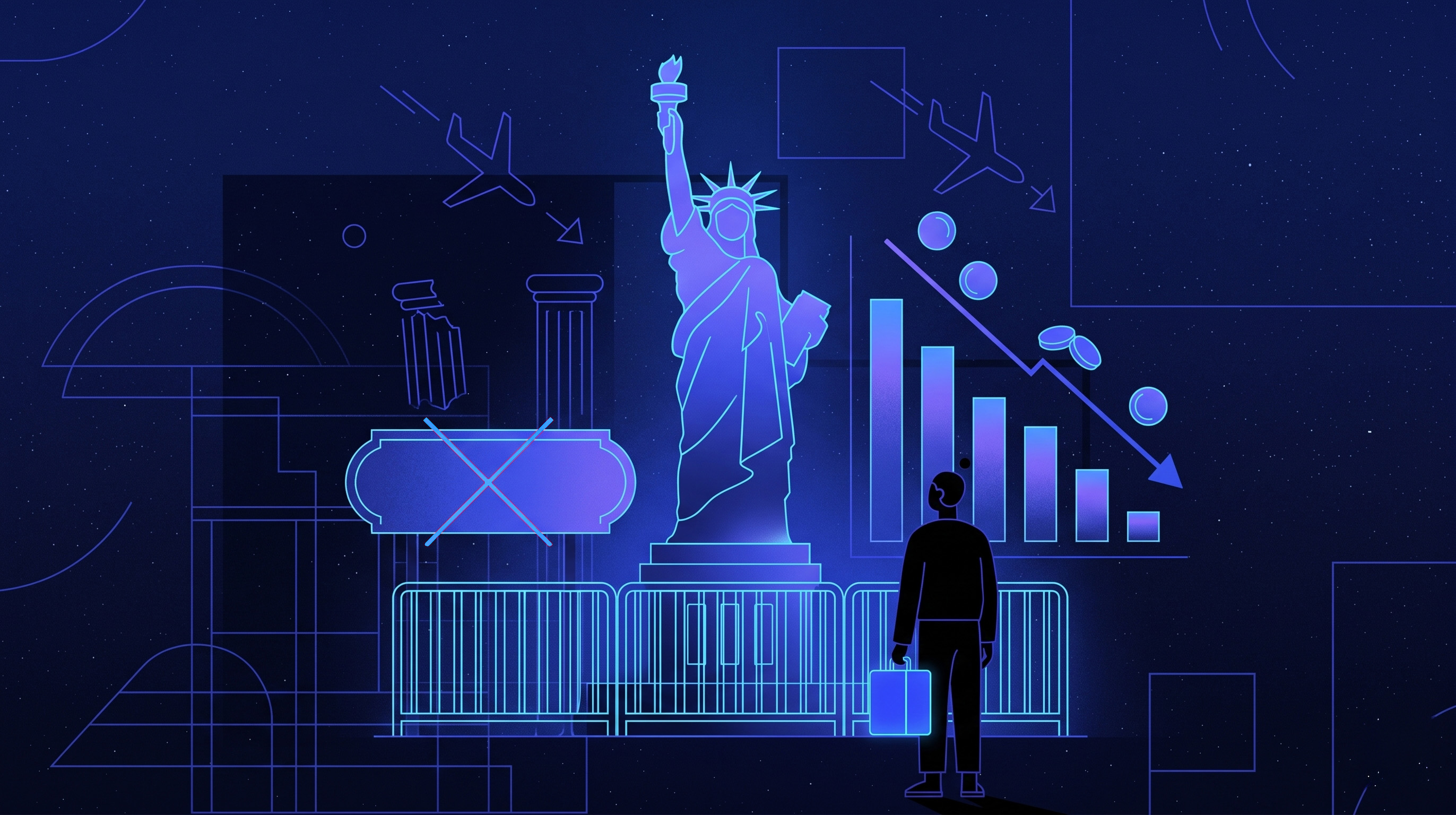
The Fourth Industrial Revolution left factories, production halls and laboratories long ago. It has sat down with us at the desk, slipped into the phone, the hotel, the hospital, the school, the city, the calendar, the wallet - and, more and more often, into our fears and our visions of the future. That is why the question is no longer only: what will technology do to industry? The question is: what will it do to the human being - and what will the human being do with it?
The revolution you can no longer hear
The First Industrial Revolution had its own sound: the whistle of steam, the clatter of wheels, the metallic breathing of machines. The second glowed with electricity and worked to the rhythm of the assembly line. The third had the hum of computers, the squeal of modems and the chill of server rooms. The fourth often has no noise of its own. It happens in a chat window, in a suggested sentence, in an app that knows our route, in a hotel system that predicts a guest's preferences, in a medical image analyzed by an algorithm and in a document that begins to write itself with us. The steam engine had a chimney. AI has a cursor.
That is why I increasingly feel that the word "industrial" is too narrow for this revolution. Yes, its roots grow out of industry: automation, robotics, the internet of things, data and cyber-physical systems. But if this change now touches education, health, finance, hospitality, loneliness, trust, relationships and the meaning of work, then it is no longer merely an industrial revolution. It is a revolution of the human being - or more precisely, a revolution of everything human beings have spent the last two centuries treating as their tools, their competences and their advantage.
Four revolutions and one uncomfortable question
The history of economic development is the history of moving the boundary between what humans do and what tools do. The first revolution gave us the steam engine and the factory. The second gave us electricity, mass production, standardization and scale. The third gave us the computer, the internet and information. The fourth gives us systems that are beginning to analyze, predict, write, speak, translate, code, design, serve customers and make decisions together with humans - or instead of them.
Every revolution promised a better world, and every revolution truly improved something. But each also created new losers, new inequalities, new dependencies and new fears. Steam pulled millions of people out of a manual economy, but placed them in factories where the human being often became an extension of the machine. The internet was supposed to democratize knowledge and, along the way, created the largest mechanisms in history for both concentrating and scattering attention. AI, too, does not arrive with a clean bill. It is neither savior nor monster. It is an amplifier - and an amplifier does not ask whether it is amplifying wisdom, greed, imagination or chaos.
When a fragment of the mind is automated
This revolution is different not because new technologies have appeared. New technologies have always appeared. It is different because this time we are automating not only muscle power, transport, production or calculation. We are automating fragments of language, knowledge, judgment, design, coordination, analysis, customer service, creativity and management. In the past, the machine replaced the hand. Later, the computer accelerated calculation. Today, a system begins to write the analysis whose author, only a few years ago, considered it his competitive edge.
For a long time we feared robots in factories. Today it would be wiser to look carefully at the calendar, the email inbox, the booking system, the CRM, the spreadsheet and the document that suggests its own next paragraphs. It is no longer only about whether a machine can lift a weight. It is about whether it will find an error in a contract faster than a lawyer after ten hours of work, whether it will predict hotel demand more accurately than a manager relying only on memory, or whether it will describe investment risk better than an analyst who only yesterday believed Excel was his natural habitat.
The Stanford AI Index 2025 shows that AI is no longer a laboratory curiosity: in 2024, 78% of surveyed organizations said they were using AI, compared with 55% a year earlier. This is no longer a conversation futurists have over coffee. It is the daily reality of boards, law firms, banks, universities, clinics, hotels, administrations and small businesses. Not everyone will be replaced. But almost everyone will be redefined.
The end of work - or the end of meaningless work?
The question "will AI take people's jobs?" is too simple, although I understand why it returns with such force. Work is not only a source of money. It is also a way of organizing the day, a place where status, dignity and belonging are built. When someone tells a person, "your tasks can be done by a machine," that person often hears, "you are less needed." That is a very serious difference.
Better questions sound different: what work will AI take away, what work will it change, and what work will it make more valuable? The International Labour Organization points out that generative AI is more likely to automate tasks than entire occupations. That sounds reassuring only until we remember that an occupation is precisely a bundle of tasks, and professional identity is often built on the most repetitive, visible and measurable ones.
We can imagine three layers of future work. The first consists of repetitive, administrative and predictable jobs - these will be automated fastest. The second consists of expert work: medicine, law, finance, architecture, education, programming and management. There, AI will not so much remove the human being as force a new level of judgment. The expert who cannot work with an intelligent tool will grow increasingly slow. The expert who trusts the tool uncritically will grow increasingly dangerous.
The third layer is work that is deeply human: rooted in trust, responsibility, empathy, taste, leadership and the capacity to accept consequences. AI can generate a recommendation, but it will not carry the moral weight of a decision. It can write a message to a hotel guest, but it will not look that guest in the eye when a journey has fallen apart because of a delayed flight and a sick child. It can assist a doctor, but it will not replace the silence after a diagnosis. It can prepare an investment analysis, but it will not assume the risk of capital and reputation.
In its Future of Jobs Report 2025, the World Economic Forum estimates that by 2030, 170 million new jobs will be created, while 92 million will disappear. The net balance is positive, but that does not mean the transition will be calm. This is not the end of work. It is a great rearrangement of the furniture. And rearrangements can be painful, especially when someone has spent an entire life at one desk and suddenly learns that the desk is now somewhere else.
The middle class before the mirror
The greatest tension concerns the middle class. For decades, social stability rested on a contract: study, acquire skills, work with your mind, and you will be relatively safe. That contract is beginning to creak. The IMF estimates that almost 40% of global employment is exposed to the impact of AI, and in advanced economies the figure is about 60%. The pressure of automation is therefore moving from production halls into law firms, banks, marketing departments, administrations, universities and consulting companies.
This is not only about the loss of jobs. It is about the loss of monopoly over a certain kind of competence. If a system can prepare the first draft of a report, compare offers, write code, summarize documents and serve part of a customer journey, the human being must move higher. It is no longer enough to perform correct tasks. One has to become someone who can ask the right question, assess the answer, take responsibility and understand the person on the other side of the process.
Data, energy, trust
The economy of the future will be based on three resources: data, energy and trust. Data will be the fuel of AI systems. Energy will be the physical limit of digital ambition. Trust will be the currency in a world of synthetic images, voices, documents, opinions, reviews, advisers and experts who may not exist.
This is one of the more beautiful paradoxes of the age: the more virtual the world becomes, the more it depends on things that are brutally material - electricity, chips, fiber optics, cooling, water, transformers, data centers, cybersecurity and stable grids. The IEA (International Energy Agency) estimates that data centers consumed about 415 TWh of electricity in 2024, roughly 1.5% of global consumption, and that by 2030 their use may rise to around 945 TWh. Virtual intelligence needs very non-virtual power.
Trust will be even harder. In a world where one can generate a CEO's voice, a politician's photograph, a customer's review, a consultant's face and an expert report, authenticity ceases to be the default. It has to be designed, protected and proven. This concerns everyone who lives from reputation. In a world of synthetic content, authenticity may become a new currency - not a brand decoration, but its hardest asset.
A smart city, or a wise city?
The fourth revolution will not happen in a vacuum. It will unfold in a world of ageing societies, overloaded healthcare systems, migration, climate change, urbanization and rising costs of living. UN DESA (the United Nations Department of Economic and Social Affairs) notes that the number of people aged 65 and over will grow from 761 million in 2021 to about 1.6 billion in 2050. The WHO reminds us that by 2050 the number of people aged 60 and over will double to 2.1 billion, while the number of people over 80 will triple to 426 million. This is not a demographic footnote. It is the new architecture of the economy, health, care, real estate, tourism and work.
Technology can help here: support diagnostics, monitor health, improve access to services, design senior-friendly cities, optimize transport, personalize education and facilitate remote work. It can make a hotel not only a place to sleep, but also a place of regeneration, prevention and a calm return to balance. From this perspective, hospitality, longevity, health and data begin to speak one language: the language of quality of life.
But the same technology can build cities that are cold, monitored and algorithmic. A smart city is not enough. We need a wise city, not merely a connected one. Cities that do not ask only how to collect traffic data faster, but also whether a child has a safe place to cross the street, whether an elderly person can reach a doctor, whether a lonely person has a place where someone will notice their absence. We will not solve loneliness merely by increasing bandwidth.
The human being as a premium good
In a world of automation, contact with a real human being may become a premium good. A doctor who truly listens. A hotelier who understands the guest before the CRM system calls it personalization. An adviser who takes responsibility rather than merely generating a recommendation. A teacher who awakens curiosity. A leader who has the courage not to hide behind a dashboard. An entrepreneur who does not only optimize, but builds meaning.
This is not a romantic escape from technology. It may be the most rational strategy in an economy in which many services become faster, cheaper and more synthetic. When everything can be generated, value attaches to what cannot be easily faked: credibility, responsibility, presence, taste, intuition, ethics and long-term reputation. When automation lowers the cost of mediocrity, the price of quality rises.
The new technological feudalism
There is, however, a darker scenario: a new technological feudalism. The greatest advantage may accrue to the owners of AI models, data, chips, platforms, cloud infrastructure, energy, talent, payment systems and the interfaces through which people come to know the world. The problem is not that AI will be "evil." The problem is that it may be extremely effective in the hands of a small number of actors optimizing reality according to their own goals.
If the citizen becomes a user, the user becomes a profile, and the profile becomes a source of data, democracy may preserve its rituals while losing part of its real agency. Companies may become so dependent on a few platforms that they resemble tenant farmers on digital land. Add to this the risk of deepfakes, information manipulation, the erosion of privacy, cyberattacks and the quiet decay of skills. AI does not have to defeat us like an enemy in a science-fiction film. It is enough for it to comfortably soften our thinking and then become the only intermediary between us and the world.
The economy of meaning
There is also a better scenario. We might call it the economy of meaning, though one must be careful: such phrases easily migrate into conference folders and die in PowerPoint. This is not about a slogan. It is about a real stage of development in which productivity ceases to be an end in itself and becomes a tool for improving quality of life.
Thanks to AI, companies can work less, but more intelligently. They can create new ventures faster, lower the cost of knowledge, improve service quality, personalize education, enhance medicine, support older people, reduce waste, manage energy better and design experiences that are more accessible, more beautiful and more dignified. This need not be a naive vision of universal prosperity. It may be a very practical model of advantage: less chaos, less repetitive work, more time for relationships, culture, care, reflection and development.
In this way of thinking, which is close to my own, technology is not a fetish. It is a tool of responsible development. A hotel, an investment project, a clinic, a restaurant, an urban space or a new service is not merely a process to be optimized. It is a human experience. Without numbers, it is easy to drift into dreams. Without the human being, it is easy to build an efficient mechanism for producing emptiness.
What does this mean?
For leaders, entrepreneurs and investors, the conclusions are practical. First: one must learn AI personally. Understanding this change cannot be delegated entirely to the IT department, just as understanding electricity could not have been delegated in a company at the beginning of the twentieth century. A leader does not have to be a programmer, but must understand how technology affects process, cost, risk, the customer, the employee and reputation.
Second: one must map the processes that can be automated and, just as consciously, identify those that should not be automated because they are sources of trust, quality or relationship. The biggest mistakes will not result only from a lack of technology. They will result from automating the wrong things. Service can be accelerated, but the sense of safety must not be lost. An offer can be personalized so deeply that instead of feeling cared for, a guest feels watched - even followed.
Third: one must build competence in data, cybersecurity, energy and critical thinking. AI is only as good as the data it works on, and only as safe as the culture of the organization using it. We need people who know how to cooperate with AI, but also how not to believe it when necessary. The modern company of the future will not simply be a technology company. It will be an organization that can combine technology, trust, operational excellence, responsibility, aesthetics, data, relationships and meaning.
AI: mirror, not oracle
There is no simple answer to whether the fourth revolution will be the end of the human being as the most important subject of the economy, or an opportunity for that human being. It can free us from some work devoid of meaning, but it can also take away status, security and a sense of worth from many people. It can help doctors, teachers, hoteliers and entrepreneurs be closer to the human being, but it can also turn relationships into interfaces and care into behavioral prediction. It can reduce inequalities through access to knowledge, but it can also entrench them through the concentration of capital and infrastructure.
AI is not a hammer. It is a mirror and an amplifier. It shows what our organizations really are: whether they have a culture of thinking or only procedures; whether they have leaders or only positions; whether they have a mission or only quarterly targets. And it amplifies what is already there: competence, chaos, courage, greed, imagination, responsibility - or the lack of it.
The Fourth Revolution left the factory and sat down with us at the desk. Then it moved into the phone, the car, the hotel, the school, the hospital, the wallet, the city and the bedroom. Nostalgia cannot stop it. Wisdom, however, can shape it. The future will not be human because technology becomes intelligent. It will be human only if people remain brave, attentive and responsible enough to use machine intelligence in the service of life, and not only of productivity.
Sources:
• World Economic Forum - The Future of Jobs Report 2025
• Stanford HAI - AI Index Report 2025
• IMF - AI Will Transform the Global Economy. Let’s Make Sure It Benefits Humanity
• International Labour Organization - Generative AI likely to augment rather than destroy jobs
• International Energy Agency - Energy and AI
• UN DESA - World Social Report 2023: Leaving No One Behind in an Ageing World
• WHO - Ageing and health
• WHO - Commission on Social Connection
• European Commission - AI Act / regulatory framework
• OECD - AI Principles